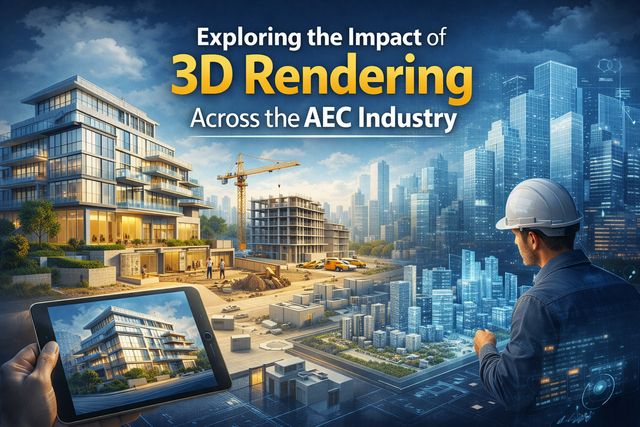
Exploring the Impact of 3D Rendering Across the AEC Industry
The AEC industry has undergone a significant shift in how projects are planned, presented, and delivered. Traditional drawings and technical plans are still essential, but they are no longer enough on their own. As projects become more complex and timelines tighter, teams need clearer ways to communicate ideas and intent. This is where specialized 3D visualization solutions have made a strong impact across architecture, engineering, and construction. By transforming design concepts into realistic visuals, 3D rendering helps teams bridge the gap between imagination and execution, long before construction begins.
Visual Clarity That Improves Design Understanding
One of the biggest challenges in the AEC industry is making sure everyone interprets the design correctly. Floor plans and elevations often require technical knowledge, which can lead to confusion for clients or non-technical stakeholders.
3D renderings present designs in a way that feels intuitive. They show scale, depth, materials, and spatial relationships clearly, making it easier to understand how a project will look and function in real life.
- Reduce misinterpretation of design intent
- Speed up internal reviews and approvals
- Align expectations early in the project
Strengthening Collaboration Between Project Teams
AEC projects involve multiple teams working together, often across different locations. Smooth collaboration is critical, yet it can be difficult when teams rely solely on drawings and written specifications.
3D rendering provides a shared visual reference that everyone can discuss and evaluate. Architects, engineers, and contractors can review the same visuals, making coordination more effective and reducing misunderstandings. This shared understanding leads to faster design coordination, fewer revisions during later stages, and better alignment between design and construction teams.
Supporting Better Decision-Making Early On
Decisions made during early design stages have a lasting impact on cost, constructability, and project success. Visualizing a design before it is built allows teams to assess options more confidently.
With the help of 3D renderings, teams can compare layouts, explore material choices, and identify potential issues early. This proactive approach helps avoid costly changes once construction is underway and supports more informed decision-making.
Improving Client Communication and Engagement
Clients are not always familiar with technical drawings or construction terminology. Realistic visuals help bridge that gap by making designs easier to understand and evaluate.
Through clear renderings, clients can visualize the final outcome with confidence, provide meaningful feedback earlier, and feel more comfortable approving design decisions. This level of engagement often leads to smoother project progress and stronger client relationships.
Practical Uses Across the AEC Industry
3D rendering is applied at various stages of AEC projects, not just for presentations. Its versatility makes it valuable throughout the design and planning process. Common uses include concept design visualization, design development and coordination, construction planning visuals, and marketing presentations.
These applications show how 3D rendering services support both technical accuracy and visual communication across different project phases.
The Value of Professional Visualization Support
As expectations for quality and detail continue to rise, many firms choose to work with specialized 3D visualization solutions to ensure consistent, high-quality results. This approach allows project teams to focus on design and engineering while maintaining strong visual communication.
Professional visualization support is especially valuable for complex projects where accuracy, realism, and turnaround time all matter.
Enhancing Efficiency and Reducing Risk
Clear visualization plays a key role in improving efficiency across AEC workflows. When teams can see potential challenges early, they can address them before they become costly problems.
3D rendering helps identify design conflicts early, reduce rework during construction, and improve overall project coordination. As a result, 3D rendering services contribute directly to time and cost savings over the life of a project.
Learning from Established AEC Workflows
The role of rendering in connecting design and execution is explored further in an article that focuses on how 3D visualization supports AEC projects, highlighting how visuals help carry design intent smoothly from early concepts to construction-ready stages. These insights reflect how rendering has evolved into a practical tool rather than just a visual aid.
Adapting to a Digital-First AEC Environment
As digital tools continue to shape the AEC industry, 3D rendering fits naturally into modern workflows. When integrated with CAD and BIM processes, rendering enhances both accuracy and communication.
With growing demand for clarity, speed, and collaboration, 3D rendering services have become an essential part of delivering successful projects in today’s AEC landscape.
By improving visualization, supporting collaboration, and enabling smarter decisions, 3D rendering has reshaped how the AEC industry approaches design and construction. Its impact can be seen at every stage of a project, helping teams turn ideas into well-coordinated, build-ready solutions with greater confidence.